Incident Response
Tabletop Exercises
Test your team's readiness before a real incident does.
Overview
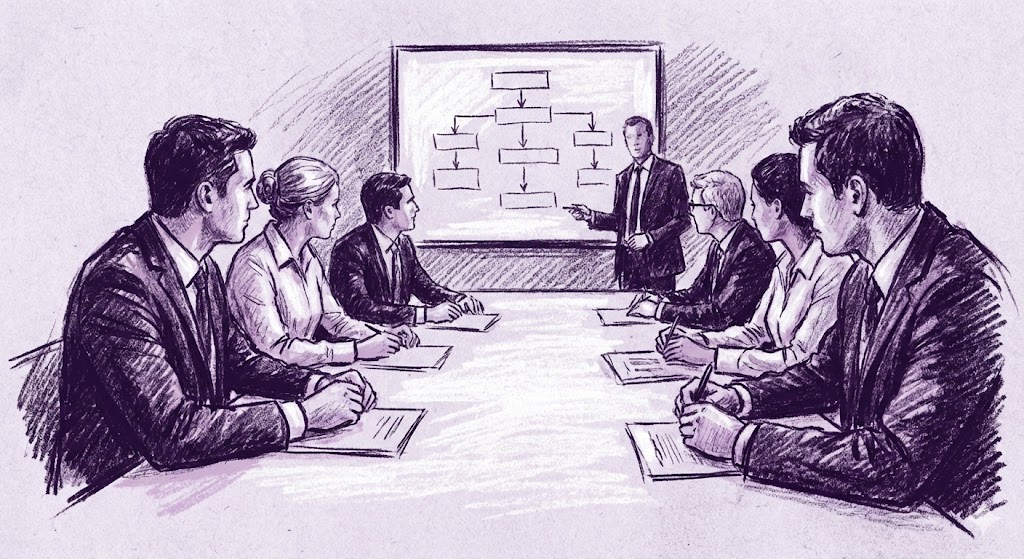
A cybersecurity incident is not the time to discover that your response plan has gaps. Tabletop exercises let your leadership and technical teams work through realistic scenarios in a low-pressure environment (surfacing weaknesses in communication, decision-making, and procedures before they cost you).
I've seen teams sit down for their first tabletop exercise and spend the first twenty minutes debating who was actually in charge. Not because they weren't capable, but because it had never been discussed out loud. In a real incident, those are twenty minutes you don't get back.
Scenario Design
We develop realistic, organization-specific scenarios based on current threat intelligence and your industry (from ransomware and data breaches to insider threats and vendor compromises).
Facilitated Exercise
Our facilitators guide your team through the scenario, prompting discussion, surfacing decision points, and ensuring all key stakeholders (IT, legal, HR, communications, and executive leadership) are engaged.
After-Action Report
Every exercise concludes with a detailed after-action report documenting findings, gaps identified, and prioritized recommendations (giving your leadership a clear picture of where to invest next).
Regulators and insurers don't just want a plan on paper. They want to know you've practiced it.
What You Can Expect
- Pre-exercise planning call to align on scope, participants, and scenario type
- A 2–4 hour facilitated tabletop session conducted annually
- Engagement of both technical and non-technical stakeholders
- Identification of gaps in your incident response plan and communication chain
- Written after-action report with prioritized recommendations
Engagement Tiers
Every organization has different needs and risk exposure. Choose the engagement depth that fits where your business is today.
The Continuity Anchor
- 60-minute focused simulation (ransomware / BEC)
- Cloud email security audit
- Remediation blueprint for your MSP to execute
- Focus on operational uptime and continuity
The Compliance Accelerator
- 90-minute virtual simulation
- Security project plan for your dev team
- Deployment validation (post-remediation check)
- Investor and insurance due diligence ready
The Scaling Shield
- 2.5-hour deep-dive (CEO, CTO, Head of Ops)
- 12-hour technical advisory bucket
- Cyber liability insurance review
- Leadership alignment and internal comms plan
The Enterprise Resilient
- Full C-suite facilitated simulation
- Deep-dive into technical architecture
- Liability and governance / GRC alignment
- Comprehensive after-action reporting
* Following initial discovery call, agreement, and deposit.
Mid-audit and things have stalled? If a SOC 2 engagement with another consultant has gone quiet, SOC 2 Rescue is a flat-fee engagement to step in, assess the situation, and get things moving again.
Who This Is For
- Organizations that have an incident response plan but have never tested it through a live exercise
- Leadership teams that need to demonstrate preparedness to a board, insurer, or regulator
- Companies in healthcare, finance, manufacturing, or retail with specific incident response requirements
- Organizations whose cyber liability insurance requires annual tabletop exercises as a condition of coverage
- Teams that experienced a real incident and need to validate their updated response procedures
Common Questions
What scenarios does a cybersecurity tabletop exercise cover?
Scenarios are tailored to your industry and threat landscape, but most commonly include ransomware attacks, business email compromise, data breach and exfiltration, insider threats, and third-party vendor compromise. We design the scenario before the exercise based on current threat intelligence and your specific environment, so it reflects a realistic threat your organization would actually face.
Who should participate in a tabletop exercise?
Tabletop exercises are most effective when both technical and non-technical stakeholders participate. That typically includes IT and security leadership, the executive team, legal counsel, HR, communications or PR, and department heads responsible for critical systems or data. The goal is to test decision-making and coordination across the entire organization, not just the technical response from IT.
Does our cyber insurance require tabletop exercises?
Many cyber liability insurers now include annual incident response testing as a condition of coverage or premium eligibility. Some policies require documented exercises with written after-action reports. If you are unsure whether your policy requires it, that is one of the areas we examine during a Cyber Liability Insurance Policy Review.
Dealing with an active incident? Reach out through the contact form. I'll quickly connect you with a qualified incident response team or help you navigate a claim through your cyber liability insurance.